
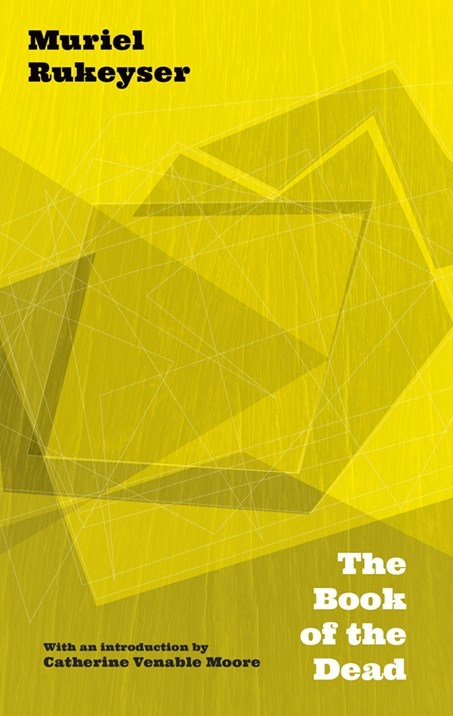
Introduction by Catherine Venable Moore
Originally appearing in Oxford American in 2016, Moore’s introduction to Rukeyer’s The Book of the Dead was as rewarding as the collection itself. Moore details her own methodology as she traces Muriel Rukseyer and Nancy Naumburg’s steps from eighty years before. Moore tells us that she’s “got a thing about falling in love with dead women writers and chasing their ghosts around West Virginia” (8). What I love about Moore’s introduction is that is it not just personal essay, but it, too, is methodology and research, even an ethnographic collection of interviews and information about the people that Rukseyer spoke to and uncovered before her. It reminds one of Alice Walker’s “Looking for Zora” or John McPhee’s “Search for Marvin Gardens” though it is also focused on providing context for Rukseyer’s collection. This is how she describes Rukseyer’s collection:
Its twenty poems recount the event at Hawk’s Nest through slightly edited fragments of victims’ congressional testimony, lyric verse, and flashes from Rukseyer’s trip south. She lifted her title from a collection of spells assembled to assist the ancient Egyptian dead as they overcame the chaos of the netherworld — “that which does not exist” — so they could be reborn. One of these texts, which concerns the survival of the heart after death, was carved onto the back of an amulet called the Heart Scarab of Hatnefer, a gold-chained stone beetle pendant that the Metropolitan Museum of Art excavated from a tomb and put on display in New York in 1936, the same year Rukseyer began her version of “The Book of the Dead” (12)
Moore’s introduction, like Walker’s essay, includes the search for a cemetery, though Moore isn’t searching for Rukseyer’s body. It’s the cemetery containing the bodies of the Black men who were originally buried in a field on the undertaker’s family farm, and then, when a highway was built decades later, whose bones were recovered and buried in small boxes on the side of the road. Moore was searching for the cemetery that the town eventually constructed when citizens heard of the story. As she contemplates this, Moore gets a call from a friend calling for advice for recovering family data. What Moore writes next is one of my favorite passages, “I told her that the thing about data is it’s not invisible; it’s there, in traces. Every byte has a physical form. Poetry, I remember thinking, fills in the gaps” (45).
Again, I was struck by how similar the poem and lyric essay can be. The gaps that history’s fragments leave can also be filled in by the meanderings of the writer collecting them, as Moore does here. As Rukseyer did in the 30s.
Steve Fellner says in his essay on fragments that “[i]f you create an essay-in-fragments, you never really have time to digress. You’re always looking for the end/ You have no time to go anywhere other than forward. Detours aren’t acceptable” (177). I thought of that fragment when I reread Moore’s thought about fragments. What if we discover the fragments and let them lead us to the detour? Don’t we always follow them where they lead us, us always at the mercy of the fragment? We’re not always looking for the end, but for what’s next. And many times, fragments don’t lead us forward, but sideways and backwards. They make us think that we are moving, progressing, but most of the time, we aren’t moving at all. Of course, Fellner was not speaking of collecting and writing with fragments — his prepositional difference here is quite significant. If we are writing an essay in fragments, then we might always be looking for the end. And maybe, if we are collecting archival fragments, we already know the end, as Moore does, and our fragments are existing only to fill in the gaps. In that way, I guess, an essay in fragments might be only digressions.
When Moore finally found the record of the persons who were employed by the company building Hawk’s Nest Tunnel or who died of Silicosis, it was potentially for movement that Moore saw: “It was the beginning of more than memory…Like Rukseyer’s poem, the list ran counter to the version of event where we all crawl off and die quietly. It held the potential to move that story, and it had been sitting here this whole time” (48).
Moore finishes her essay vulnerably, worrying that “instead of resurrecting, I had desecrated the resting — ghosts who had never elected me their spokesperson. The names of the Hawk’s Nest dead gave me powers I wasn’t sure I deserved” (50), and significantly, drawing connections to the racism and oppression and classism that still exist today: “The same white supremacy that allowed, condoned, and covered up the mass killing as Hawk’s Nest still asserts its dominance. The road of history is flooded with all of this, and so am I. But this is the road I must go down. It’s the only one we have” (51).
Works Cited
Fellner, Steve. “On Fragmentation.” Bending Genre: Essays on Creative Nonfiction, edited by Margot Singer and Nicole Walker, Bloomsbury, 2013. pp. 175-179.
Pairings: Any essay in which a writer is searching for someone/something. “Looking for Zora” by Alice Walker and “The Search for Marvin Gardens” by John McPhee are the ones I mention above, which would be helpful pairings here, but I could also see photography pairings (since the book includes photographs) or archival research pairing well with this book depending on the research interest/focus of the writers or class.
 Compsing