
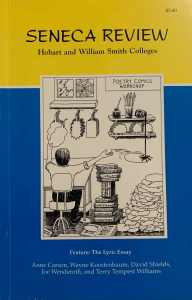
Overview. Deborah Tall and John D’Agata’s introductory note in the Fall 1997 issue of Seneca Review is one of the most cited and referenced description of the lyric essay. It is a great starting point for anyone curious about the lyric essay. The page and a half note is beautiful and poetic, like the essays they describe. And, like the essays they describe, this note is also evasive and mysterious, never really pinning down the lyric essay’s parameters.
“The lyric essay,” Tall and D’Agata write, “partakes of the poem in its density and shapeliness, its distillation of ideas and musicality of language. It partakes of the essay in its weight, in its overt desire to engage with facts, melding its allegiance to the actual with its passion for imaginative form” (7).
Here again, “The lyric essay does not expound. It may merely mention” and again, “The stories it tells may be no more than metaphors” (7, 7).
This slipperiness used to frustrate me, but now, I can only think of it as apropos. This note is a must-read for anyone studying the lyric essay and it is available online on Seneca Review‘s website. The online and print version are almost identical1 making it a very accessible starting point. However, if you can get your hands on the print issue, I would recommend it, as it does contain many examples of the lyric essay as Tall and D’Agata are thinking of it.
Suggested Pairings. This would be helpful to pair with other writers’ discussions of the lyric essay. The introduction to Shapes of Native Nonfiction: Collected Essays by Contemporary Writers by Elissa Washuta and Theresa Warburton would be a helpful pairing (and they also reference Tall and D’Agata’s text in their introduction). Another helpful pairing would be the short introductory note in the Seneca Review Special Edition on the Lyric Essay edited by D’Agata, We Might As Well Call It the Lyric Essay, in which D’Agata responds to his co-authored note here.
- The first sentence of the print version reads, “With this issue, Seneca Review begins to publish what we’ve chosen to call the lyric essay” (7) while the first sentence of the online version reads, “With its Fall 1997 issue, Seneca Review began to publish what we’ve chosen to call the lyric essay.” This is the only difference I have identified between the two versions.
 Compsing